Aikido
Blending with an attack. Aikido, developed by Morihei Ueshiba in Japan, uses joint locks, throws and movement to redirect an attacker's force. How classes work and its styles.
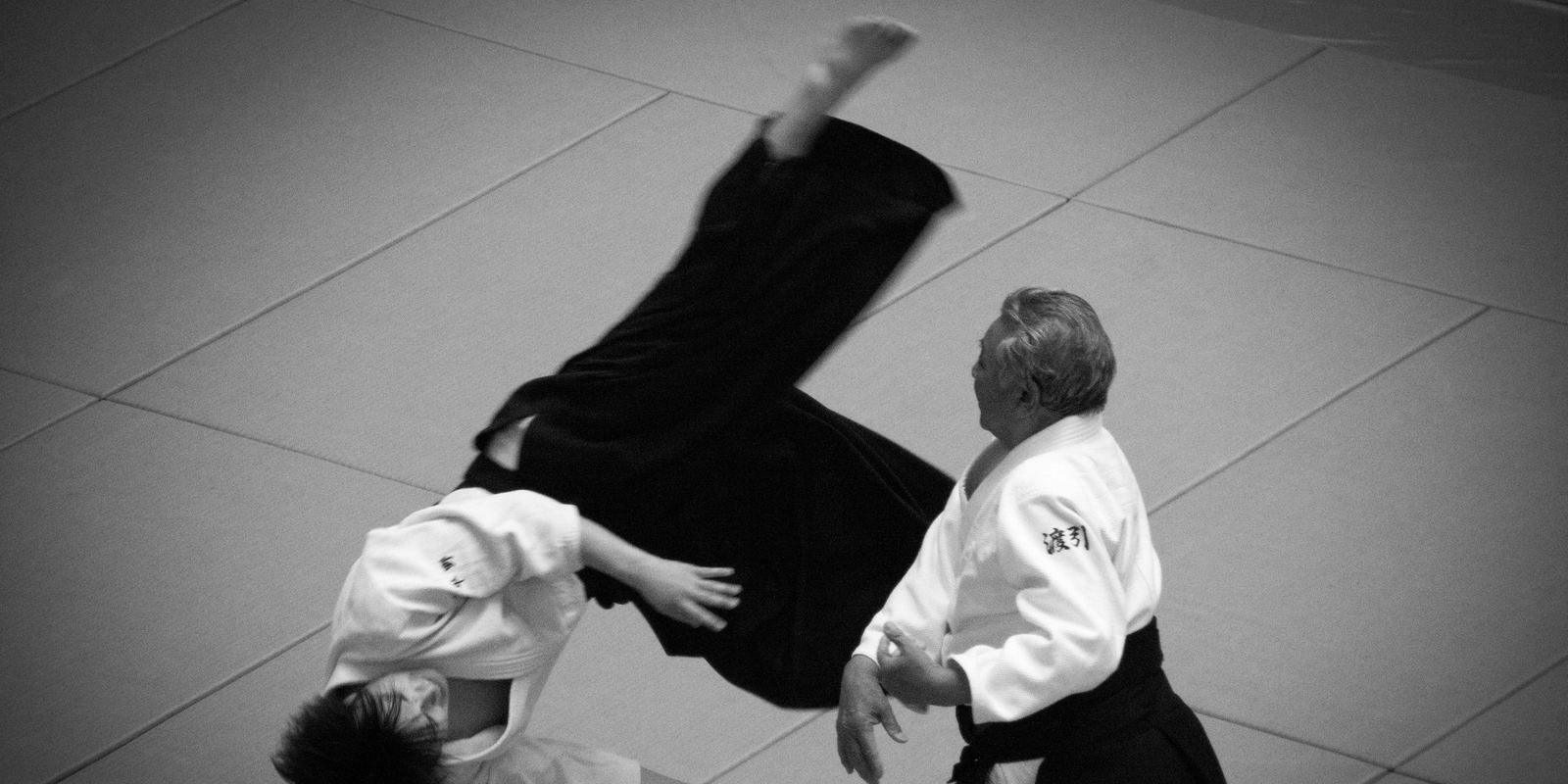
All Japan Aikido Demonstration, 2013: L'oeil étranger, CC BY 2.0
What aikido is
Aikido is a Japanese martial art that focuses on redirecting an attacker's energy rather than meeting force with force. Practitioners move off the line of attack, blend with the motion and apply a throw, a joint lock or a pin. The name is usually translated as the way of harmonising energy.
How classes work
Training is done in pairs. One partner, the uke, attacks with a grab or strike and receives the technique, while the other, the nage or tori, performs it. Then they switch roles. Learning to fall safely, called ukemi, is one of the first and most important skills, and good ukemi is a big part of what makes aikido look so flowing.
Styles
After the founder's death in 1969, students developed several styles. Aikikai, based at the Hombu Dojo in Tokyo, is the largest. Yoshinkan aikido is known for precise, strong basics. Shodokan, or Tomiki aikido, includes competitive formats. Some schools practise with a wooden sword and staff, the bokken and jo, to teach timing and distance.
Did you know?
Aikido has its own kind of public showcase: the All Japan Aikido Demonstration, held at the Nippon Budokan in Tokyo, where thousands of practitioners of all ages perform techniques in front of an audience. There are no winners or losers; the aim is to show skill and harmony. Training with partners of different sizes and ages is part of the art, and many dojos welcome older beginners who want a low-impact practice that still teaches real skills such as balance, posture and falling safely.
Strengths and limits
Aikido is excellent for balance, coordination, falling skills and calm under pressure, and it suits people of many ages. Because most styles do not include sparring against fully resisting partners, some critics question its effectiveness in real conflict. Many practitioners train it for movement, fitness and personal development, and some cross-train in judo or jiu-jitsu.
Learn techniques only from a qualified instructor in a supervised class, with proper equipment and a partner who knows what to expect.
- All Japan Aikido Demonstration, 2013: L'oeil étranger, CC BY 2.0
Text written by Strongest Power.